

Vaping’s safety conversation usually happens at the wrong altitude — grand debates about long-term epidemiology — while the practical safety that actually touches vapers’ lives goes untaught: the lithium battery in your pocket, the nicotine liquid on your shelf, the toddler and the spaniel who share your home, and the counterfeit market that mimics everything you buy. The reassuring truth is that day-to-day vaping safety is almost entirely a checklist, and a short one; the sobering truth is that nearly every vape-related incident that reaches the news traces to one of perhaps six checklist items being skipped. This guide covers all of them properly: battery and charging safety, safe liquid handling and storage, child and pet protection, device hygiene, the authenticity habits that keep fake products out of your rotation, and where the genuine risks rank against the mythical ones. Learning how to vape is the skill; this is the seatbelt that goes with it.
Batteries: Respect, Not Fear
Every vape runs on a lithium cell — the same chemistry as your phone — and lithium is superbly safe under normal use and unforgiving of specific abuses. For the built-in batteries in modern pod kits, the rules are few: charge with a reputable mains adapter and a standard lead rather than an anonymous fast-charging brick; charge somewhere observable rather than under a pillow or overnight on bedding; keep the device out of heat, with parked cars in summer as the named villain; and retire immediately — no heroics — any device that swells, gets abnormally hot at rest or while charging, rattles, or smells chemical. For the removable batteries in larger hobbyist mods, add the classics that cause most incidents in the entire category: never carry loose cells in a pocket or bag with keys and coins (metal bridging the terminals is the textbook vape-battery fire), keep wraps intact and re-wrap or retire damaged ones, use a proper charger and matched cells. Read the incident reports behind vaping’s battery headlines and the same two stories repeat: loose batteries meeting pocket metal, and cut-price chargers meeting overnight neglect. Both are fully optional.
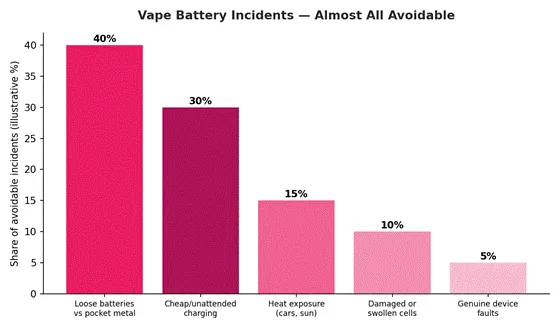
Where battery incidents actually come from — the avoidable causes behind the headlines.
Nicotine Liquid Is a Poison Cupboard Item
Vapers habituate to e-liquid as a benign consumable, and for its intended use it is — but concentrated nicotine is genuinely toxic if swallowed or heavily spilled on skin, and it deserves the same household respect as medicines. The handling rules: wash off meaningful skin spills promptly with soap and water (trace contact from refilling is trivial; a soaked patch of skin is not); never decant liquid into unmarked or food-adjacent containers, where the tragic-mistake potential lives; keep caps on and childproofing engaged, always, even mid-session; and if significant ingestion ever occurs — by anyone — treat it as the medical situation it is and seek immediate advice rather than waiting to see. UK retail liquids come in childproof 10ml bottles with compliant labelling for exactly these reasons; the system works when the cap goes back on.
Children: The Non-Negotiables
Households with children run a stricter rulebook, and it has three clauses. Storage: all liquids, pods and devices live high, closed and ideally locked — sweet-smelling liquid in bright packaging is precision-engineered, unintentionally, to interest a toddler, and small pods are additionally a choking hazard; the kitchen-counter charging habit is the one to break first. Modelling: vape away from children, entirely — not for vapour-exposure reasons alone but because the deepest child-safety mechanism is never normalising the behaviour; the habit they never watch is the habit they are least likely to explore. Conversation, for older kids and teens: the honest line is simple and worth scripting — this is a tool for adult smokers getting off cigarettes, it is not for you, and the law agrees; deflection breeds curiosity where a straight answer closes it. Every UK vaper is also part of the enforcement picture: never buy for, share with, or wave through anyone under 18, however socially awkward the refusal — the age line is the whole deal society made with this product category.
Pets and the Shared Household
The animal chapter is short and mostly about dogs, who investigate with their mouths. Nicotine is toxic to pets at small doses relative to their weight — a chewed pod or bottle is an emergency vet visit — so the child-storage rules extend to anywhere a determined labrador reaches, and used pods go into closed bins, not open wastebaskets at nose height. Vapour itself: exhale away from animals as a courtesy and keep birds out of vaping rooms entirely, since avian respiratory systems are famously delicate with any airborne compound. Symptoms after suspected ingestion — vomiting, drooling, agitation, tremors — mean the vet now, with the product packaging in hand. The whole chapter compresses to one habit: treat every liquid-bearing item as the poison-cupboard item it is, for every mouth in the house that isn’t yours.
The Counterfeit Problem, Practically
The least discussed and most consequential consumer-safety issue in vaping is fakes. Counterfeit and grey-market products — cloned pods, mimicked liquids, illegally strong imports — are where the category’s real chemical risk concentrates, because an unregulated liquid is an unknown liquid: unknown ingredients, unknown strength, none of the UK’s testing and notification requirements. The infamous 2019 lung-injury outbreak in the United States, still misattributed to vaping generally, traced overwhelmingly to illicit cannabis-oil cartridges cut with vitamin E acetate — the definitive case study in why regulated retail products and black-market cartridges are different universes. The protective habits: buy from established UK specialists rather than marketplaces and market stalls; check every product for the compliance signature — UK nicotine warning, strength at or below the legal 20mg, ingredients, a real UK responsible-party address; treat impossible prices and impossible claims (anything above 20mg, anything ‘stronger than legal’) as the confessions they are; and never vape a cartridge or liquid of unknown provenance handed along socially. A reputable specialist such as pink vape clears the entire checklist by default across its range, which converts this whole section into a single shopping decision.
Device Hygiene and Everyday Sense
The remaining risks are small and domestic. Hygiene: the mouthpiece is a high-touch surface — wipe it regularly, don’t share devices (colds travel), and clear condensation with dry tissue. Chain-vaping marathons: beyond wasting liquid, they can outrun wicking into hot harsh territory and deliver more nicotine than intended — the queasy, headachy signature of overdoing it, which resolves with air, water and stopping, and which bounded sessions prevent entirely. Dropped and damaged kit: a cracked pod leaks and a dented device with a battery inside earns retirement, not duct tape. DIY temptations: leave rebuilding, battery surgery and liquid-mixing chemistry to the experienced hobbyists who study it; the mainstream kit exists so nobody needs a workbench. None of this list is frightening — it is the same tier of sense as kettle cords and bike lights, applied to a pocket device.
Ranking the Risks Honestly
Perspective is itself a safety tool, so rank the register. At the top, by orders of magnitude, sits the risk vaping exists to displace: smoking, whose harms are vast, certain and paid by millions — the UK public-health consensus that vaping is far less harmful than smoking is the entire foundation of its place in British health policy, and no item in this guide dents it. Below that: the avoidable, concrete risks this article exists for — battery abuse, liquid ingestion by children and pets, and counterfeit products — each rare, each headline-generating, each essentially eliminated by the checklists above. Below those: the genuinely open questions of very-long-term use, which honest vapers acknowledge and which argue for the step-down path rather than panic. And at the bottom: the myths — the scares that dissolve under regulation and evidence. A vaper who smokes nothing, charges sensibly, stores like a parent, and buys genuine has quietly exited almost every risk category worth the name.
The Household Safety Audit
The guide as a fifteen-minute audit, worth running today: chargers reputable and charging visible; no loose cells anywhere near metal, no swollen or hot hardware in service; every liquid and pod capped, high and closed away from children and pets, nothing decanted, nothing in reach; used pods binned closed; every product in the house bearing the UK compliance signature, and the shopping bookmark pointing at a specialist that guarantees it; mouthpieces clean, sessions bounded, damaged kit retired. Fifteen minutes, most of it confirming what is already true — and the entire practical risk surface of the habit shrinks to statistical noise. Repeat quarterly, or whenever the household changes.
Safety FAQs
The questions this checklist raises. Is it dangerous to vape while charging? On reputable modern kits with pass-through support it is designed-for; the sensible caveats are a quality adapter and not doing it on bedding — heat needs escape routes. My device fell in water — now what? Off, dry thoroughly for a day or more, and if it behaves oddly afterwards, retire it; water plus lithium plus optimism is a bad recipe. How do I dispose of a dead device or battery? Small-electricals recycling or vape-shop take-back, never household bins — crushed cells in bin lorries start real fires. Is second-hand vapour dangerous to my family? Evidence to date indicates bystander risk is low and nothing like smoke — but courtesy and the children’s rule (vape away from them regardless) stand on their own feet. Can liquid go ‘off’ dangerously? It degrades in quality — darkening, peppery notes — rather than becoming hazardous; the danger category is unknown-provenance liquid, not old genuine liquid. And the question behind the whole guide — is vaping safe, full stop? Safer than smoking by a wide margin per UK public-health assessment, not risk-free, safest when every checklist above is boringly followed — and irrelevant to anyone who never starts.
The Bottom Line
Vaping safety is not a debate to win but a checklist to run: respect the lithium, cupboard the nicotine, shield the children and pets absolutely, buy genuine without exception, and keep the everyday sense switched on. Every dramatic incident in the category’s history is a skipped line from that list, and every line costs seconds. Underneath the practicalities sits the honest frame worth restating at the close: for adult smokers, the overwhelmingly dominant safety move is the switch itself, and everything in this guide exists to make the safer habit safer still — while for anyone outside nicotine, under 18 or otherwise, the safest relationship with all of it remains none at all.
